
We’ve all been there. You just learned the riff to “Whole Lotta Love,” you plug into your 50-watt tube combo, and you turn the volume to… 0.5. Suddenly, your legendary rock-and-roll machine sounds like a bumblebee trapped in a tin can. The “sweet spot” of your amp is somewhere near the volume level that would cause a structural failure in your apartment building—and a prompt eviction notice from your landlord.
Finding the best bedroom guitar amps isn’t just about finding the smallest box in the music store. It’s about finding a tool that can replicate the feel, dynamics, and harmonic richness of a cranked stage rig at a volume that won’t wake the baby in the next room. In this guide, we’re going to look at the technology that makes great low-volume tone possible and review the top contenders that will make your bedroom feel like Wembley Stadium—without the noise complaints.
Why “Bedroom Tone” is a Different Beast
In a live setting, volume is your friend. It pushes the air, moves the speaker cone, and causes the vacuum tubes (if you have them) to compress and saturate in a way that feels “alive.”
In a bedroom, volume is your enemy. When you turn a traditional amp down to “bedroom levels,” you encounter two main problems:
- The Fletcher-Munson Curve: Human ears perceive frequencies differently at lower volumes. We lose our sensitivity to bass and treble, making the amp sound “thin” or “boxy.”
- Lack of Speaker Excursion: Speakers need a certain amount of energy to move efficiently. At low volumes, the speaker isn’t “working,” leading to a stiff, unresponsive feel.
The best bedroom guitar amps solve these issues using power scaling, digital modeling, or advanced headphone circuitry to ensure you get that “cranked” feel at conversation levels.
Buyer’s Guide: What Makes a Great Bedroom Amp?
Before you swipe your card, you need to understand the specs that actually matter for home use. Forget “loudness”; we’re looking for “versatility.”
1. Wattage and Power Scaling
A 100-watt Marshall stack is a Ferrari; a bedroom is a school zone. You can’t drive the Ferrari at 100mph in a school zone, and you can’t crank a 100-watt amp in a bedroom. Look for amps with Variable Power Scaling. This allows you to drop the output from, say, 50 watts down to 0.5 watts. This lets you push the internal circuitry of the amp into saturation without the deafening decibels.
2. Headphone Outputs and IRs (Impulse Responses)
A standard “headphone out” often sounds like garbage because it lacks “cabinet simulation.” The best bedroom guitar amps utilize IRs (Impulse Responses). These are digital snapshots of real speakers and microphones. When you plug in your headphones, the IR makes it sound like you’re listening to a professionally mic’d 4×12 cabinet in a world-class studio.
3. Digital vs. Tube vs. Solid State
- Tube Amps: Traditionally “the best” tone, but they need volume to sound right. Look for “Low Wattage” tube amps (1–5 watts) with built-in attenuators.
- Digital Modeling: Currently the king of the bedroom. These amps use computer processing to mimic famous rigs. They sound exactly the same at 1% volume as they do at 100%.
- Solid State: Reliable and clean. Great for pedal platforms, though sometimes lacking the “feel” of the other two.
4. Built-in Effects and Connectivity
Space is a premium in a bedroom. An amp with built-in reverb, delay, and modulation saves you from a messy floor of pedals. Furthermore, Bluetooth connectivity is a game-changer for playing along with backing tracks or YouTube lessons.
Top Picks: Comparison Table
| Brand & Model | Wattage | Speaker Size | Signal Options | Price Range | Who It’s For |
|---|---|---|---|---|---|
| Boss Katana-50 MkII | 50W (to 0.5W) | 12″ | USB, Headphone, Aux | $250 – $300 | The “Do-Everything” Player |
| Yamaha THR30II WL | 30W | 2 x 3″ | Wireless, USB, BT | $450 – $500 | The Desktop Connoisseur |
| Positive Grid Spark 40 | 40W | 2 x 4″ | USB, BT, Smart App | $250 – $300 | Tech-savvy Learners |
| Blackstar HT-1R MkII | 1W | 8″ | USB, Emulated Out | $300 – $350 | Tube Purists |
| Fender Mustang LT25 | 25W | 8″ | USB, Headphone | $150 – $180 | Budget-conscious Beginners |
| Orange Micro Dark | 20W (Hybrid) | N/A (Head) | Headphone (Cab Sim) | $180 – $200 | High-Gain Metalheads |
| Roland JC-22 | 30W | 2 x 6.5″ | Line Out, Headphone | $450 – $500 | Clean & Pedal Enthusiasts |
| Revv G20 | 20W (to 4W) | N/A (Head) | Two Notes Torpedo Built-in | $1,100+ | The Pro Recording Bedroom |
| Vox Adio Air GT | 50W | 2 x 3″ | BT, USB, Headphone | $300 – $330 | Those who want a “Hifi” look |
| Line 6 Catalyst 60 | 60W (to 0.5W) | 12″ | USB, XLR Out | $280 – $320 | Modern Gig/Home Hybrid |
The Deep Dive: Reviewing the Best Bedroom Guitar Amps
1. Boss Katana-50 MkII: The Swiss Army Knife
The Boss Katana has become the “standard” for a reason. Its power scaling feature is the star of the show; you can set it to 0.5 watts and get the response of a high-gain monster at a level where you can still hear your own breathing.
- Tone: Versatile. From sparkling cleans to “Brown” sound (EVH style) distortion.
- Pros: Incredible value; access to 60+ Boss effects via software.
- Cons: The “Tone Studio” software can be intimidating for non-techies.
2. Yamaha THR30II Wireless: The Desktop King
Yamaha pioneered the “Third Amp” concept—the idea that you have your stage amp, your practice amp, and your “desktop” amp. The THR30II is designed to sit next to your computer. It looks like a high-end radio and sounds like a professional studio recording.
- Tone: Hi-Fi. The stereo speakers create a massive soundstage.
- Pros: Wireless capability (no cables!); beautiful aesthetics.
- Cons: Expensive for its size; small speakers lack “thump.”
3. Positive Grid Spark 40: The Smart Companion
If you enjoy using your phone to control your gear, the Spark is unbeatable. Its app can analyze any YouTube song and show you the chords in real-time. It’s not just an amp; it’s a guitar teacher.
- Tone: Very bass-heavy (some say too much), but highly tweakable.
- Pros: Over 10,000 tones in the cloud; smart jam features.
- Cons: Can sound a bit “processed” compared to a real tube amp.
4. Blackstar HT-1R MkII: Real Tubes, Real Quiet
For some, digital modeling is a four-letter word. The HT-1R is a genuine valve (tube) amp. It uses a push-pull design to give you that organic tube compression at just 1 watt of power.
- Tone: British crunch and boutique cleans.
- Pros: Real tube feel; great “Infinite Shape Feature” (ISF) for EQ.
- Cons: No built-in effects other than reverb; 8″ speaker is small.
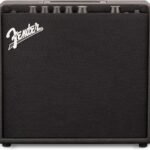
5. Fender Mustang LT25: The Beginner’s Best Friend
Fender knows how to make a clean channel. The LT25 packs decades of Fender history into a tiny, affordable box. It’s simple to use—just turn the knob to a preset and play.
- Tone: Classic Fender cleans are the highlight.
- Pros: Very affordable; lightweight.
- Cons: Distortion sounds can be a bit “fizzy” compared to more expensive models.
6. Orange Micro Dark: The Lunchbox Terror
This is a hybrid head, meaning it has a tube in the preamp and a solid-state power section. It’s about the size of a toaster but packs enough gain to level a city block. Crucially, the headphone output features a cabinet simulator that is surprisingly good.
- Tone: Thick, dark, and aggressive.
- Pros: Iconic Orange gain; highly portable.
- Cons: Requires a separate speaker cabinet (unless using headphones).
7. Roland JC-22: The Cleanest Canvas
Based on the legendary Jazz Chorus, this small combo offers the most pristine clean tone on the market. If you are a pedalboard enthusiast who gets all their drive from pedals, this is your perfect bedroom platform.
- Tone: Crystal clear with an iconic stereo chorus.
- Pros: True stereo operation; indestructible build.
- Cons: Not meant for “amp distortion”; can be pricey.
8. Revv G20: The Professional’s Choice
This is a high-end piece of gear. It’s a 20-watt tube head with a “Two Notes Torpedo” load box built-in. This means you can play it without a speaker cabinet at all, sending a studio-quality signal straight to your headphones or interface.
- Tone: Modern, tight high-gain.
- Pros: Industry-standard cabinet simulation; reactive load.
- Cons: Very expensive; requires external speakers/headphones.
How to Make Any Amp “Bedroom-Friendly”
Maybe you already have an amp you love, but it’s just too loud. You don’t necessarily need to buy a new one of the best bedroom guitar amps if you follow these tips:
- Use an Attenuator: This device sits between your amp head and your speaker. It “soaks up” the extra volume and turns it into heat, letting you crank the amp while keeping the output quiet.
- Get it Off the Floor: If you have neighbors below you, bass frequencies travel through the floorboards like a sonic earthquake. Put your amp on a stand or a chair to decouple it from the floor.
- The “V” EQ Shape: Because of the Fletcher-Munson curve mentioned earlier, try boosting your Bass and Treble slightly when playing at low volumes to compensate for your ears’ lack of sensitivity.
- Invest in Studio Headphones: A $200 amp with $150 studio headphones (like the Beyerdynamic DT 770) will sound 10x better than a $1000 amp with cheap earbuds.
Common Mistakes Beginners Make
- Chasing Wattage: Beginners often think “20 watts isn’t that much.” In reality, a 20-watt tube amp is loud enough to play a small club. For a bedroom, 1 to 5 watts is more than enough.
- Ignoring the Headphone Jack: Many high-end tube amps do not have headphone jacks. If you live in an apartment, check this spec twice before buying!
- Buying for “Future Gigs”: Don’t buy a 100-watt half-stack because you “might” join a band next year. Buy the amp that makes you want to practice today. You can always buy a louder amp later.
What the Enthusiasts Say
“I spent years trying to make my 50W Marshall work at home. I finally bought a Yamaha THR, and my practice time tripled. When the tone is good at a volume that doesn’t annoy my wife, I actually want to play.” — Mark S., GearForum Member
“The secret to bedroom tone is the IR. Once I realized that the ‘speaker’ was 80% of the sound, I stopped buying big amps and started buying better digital plugins and small modeling units.” — Sarah T., Session Guitarist
Conclusion: Finding Your Perfect Match
Choosing the best bedroom guitar amp comes down to your personal workflow.
- If you want simplicity and value, the Boss Katana-50 is the undisputed king.
- If you want a permanent desktop companion that looks like a piece of art, go for the Yamaha THR30II.
- If you are a purist who needs the smell of warm vacuum tubes, the Blackstar HT-1R will satisfy your soul without shattering your windows.
Remember: Your amp is your partner in practice. If it sounds bad at low volumes, you won’t want to play. Invest in a tool that makes your bedroom feel like a creative sanctuary, not a place where you’re constantly fighting with the volume knob.
FAQ: Frequently Asked Questions
Can I use headphones with any amp?
No. Many traditional tube amps do not have a headphone jack. Furthermore, you should never unplug a tube amp’s speaker and leave it running without a “load box,” or you could blow the transformer. Always check for a dedicated “Phones” or “Emulated Out.”
Is a tube amp always better than a digital amp?
Not anymore. While tubes have a specific “feel,” modern digital modeling (like in the Spark or Katana) is so good that in a blind taste test, most listeners can’t tell the difference—especially at low volumes.
Will a 1-watt amp be quiet enough for an apartment?
Surprisingly, 1 watt can still be quite loud! However, most 1-watt amps are designed to break up (distort) at lower decibel levels, making them much more manageable than a 15 or 30-watt amp.
Do I need a 12-inch speaker for home use?
A 12-inch speaker provides more “thump” and low-end, but it also moves more air. For pure bedroom use, 8-inch or even 3-inch speakers (in the case of the Yamaha THR) are often better because they don’t produce the neighbor-annoying sub-bass frequencies.
Did this guide help you find your next rig? Whether you’re looking for a high-tech modeler or a tiny tube screamer, the right tone is out there. Let us know in the comments which amp you chose for your bedroom setup!